Backgammon Rules: How to Play, Hitting, Bearing Off
Updated: · 🔗 Online with a friend📱 2 players, same device🤖 Vs computer🌍 Random opponent
Backgammon is a classic two-player strategy game played with 15 checkers each and a pair of dice. The goal is to move all your checkers around the board into your home board and bear them off before your opponent. Zipi uses the traditional rules played in Turkey (tavla): hitting, the bar, bearing off and gammons, with no doubling cube.
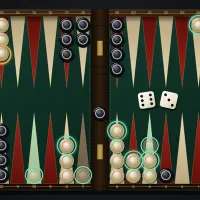 ▶ Play Backgammon nowFree, no download, no sign-up.
Board, checkers and setup
The board has 24 points (triangles), and each player has a six-point home board. Numbering the points 1 to 24 from your own side, your home is points 1-6 and your checkers travel from 24 down to 1. Your opponent moves the opposite way.
Each player's 15 checkers start like this:
| Point (your view) | Checkers |
|---|---|
| 24 (deep in the opponent's home) | 2 |
| 13 | 5 |
| 8 | 3 |
| 6 (your home) | 5 |
The divider in the middle is the bar, where hit checkers wait.
Who goes first
Each player rolls one die and the higher roll goes first, then rolls both dice again for the opening move. Ties are re-rolled. In later games of a match the winner of the previous game starts.
Zipi variant: under international rules the two opening dice are played as the first move. Zipi follows the common Turkish custom where the player who wins the opening roll rolls again.
Moving rules
- Each die is a separate move. With 6-3 you move one checker 6 and another 3, or one checker 9 if the intermediate point is open.
- Rolling doubles lets you play that number four times.
- A checker may land on an empty point, a point with your own checkers, or a point with a single opposing checker.
- A point with two or more opposing checkers is blocked.
- You must use both dice if possible. If only one can be played, you must play the higher one when it is playable; otherwise the lower. With no legal move, your turn passes.
Zipi works out the legal moves for you: tap a checker and its destinations light up.
Hitting and the bar
Landing on a single opposing checker (a blot) hits it and sends it to the bar. A player with a checker on the bar must bring it back into the opponent's home board before making any other move. You enter on the point matching a die: rolling a 4 lets you enter on the opponent's 4-point (your 21-point) if it is open, yours, or holds a single opposing checker, which you hit. If both points shown by the dice are blocked, you lose your turn.
Bearing off
Once all 15 checkers are in your home board (points 1-6) you may start bearing off:
- Roll the number of a point and you remove a checker from it: a 5 removes a checker from the 5-point.
- You may also use a die to move checkers within your home board.
- If the die is higher than your furthest checker (say you roll 6 with nothing on the 6- or 5-point), you bear off from your highest occupied point.
If one of your checkers is hit during bear-off, you cannot continue until it has re-entered and come back home.
Winning, gammons and match points
| Result | Points won |
|---|---|
| Single game: the opponent has borne off at least one checker | 1 |
| Gammon: the opponent has borne off none | 2 |
In Zipi a match is played to 3 or 5 points (online matches go to 3). The first to the target wins the match.
Zipi variant: international backgammon adds the doubling cube and a three-point backgammon when the loser still has a checker on the bar or in the winner's home board. Zipi has neither; any game where the loser bore off nothing is a 2-point gammon.
Common mistakes
- Leaving needless blots: a lone checker within six points of an enemy checker is hit very often.
- Racing too early: running without building points at home makes it hard to recover after being hit.
- Forgetting the back checkers: the two checkers on your 24-point can get trapped late in the game.
- Ignoring the higher-die rule: if only one die can be played, it has to be the higher one when possible.
Backgammon strategy tips for beginners
- Learn the best openings: 3-1 makes your 5-point (from the 8 and 6), 4-2 makes your 4-point and 6-1 makes your 7-point.
- Build points at home: the more blocked points you have, the harder it is for a hit checker to re-enter.
- Count pips: if you are ahead in the race, run; if you are behind, keep back checkers to hit later.
- Choose safe risks: if you must leave a blot, put it where the fewest rolls hit it.
- Bear off carefully: while the opponent has a checker on the bar or behind you, avoid leaving blots.
- Go for the gammon: if your opponent is far behind, fast bearing off can earn 2 points.
Play backgammon online on Zipi
Backgammon runs in your browser on Zipi with no account. Against the computer, Easy is for learning, while Hard weighs pip counts, blots, blocked points and hitting chances. You can also play a friend on the same device. Online, Play with a friend creates a five-letter room code and invite link, and Find a world opponent matches you with someone who wants a game now. In online matches the host's device rolls the dice and both screens see them at once; each turn lasts 60 seconds.
FAQ
What is a gammon worth?
If you bear off all your checkers before your opponent bears off any, you win a gammon worth 2 points. A normal win is 1 point.
Do I have to use both dice?
Yes, whenever both can be played. If only one can be played, you must play the higher die if possible.
What happens to a hit checker?
It goes to the bar, and its owner cannot move any other checker until it re-enters in the opponent's home board.
When can I start bearing off?
As soon as all 15 of your checkers are in your home board, the last six points.
How do doubles work?
You play the number four times. Rolling double 4 lets you make four moves of 4 points each.
Who goes first in backgammon?
Each player rolls one die; the higher roll starts and then rolls both dice. In later games of a match the previous winner starts.
Is there a doubling cube on Zipi?
No. Zipi uses traditional Turkish rules without the doubling cube, and matches are played to 3 or 5 points.