Chess Rules: How the Pieces Move, Castling and Checkmate
Updated: · 🔗 Online with a friend📱 2 players, same device🤖 Vs computer🌍 Random opponent
Chess is a strategy game for two players, each with 16 pieces on a 64-square board. The goal is to checkmate the opponent's king: attack it so that it has no way to escape. Zipi's chess applies the complete rules, including castling, en passant, promotion, stalemate and every draw rule.
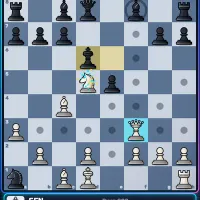 ▶ Play Chess Online nowFree, no download, no sign-up.
The board and setup
The board is 8×8, placed so each player has a light square in the right-hand corner. Columns are files a-h and rows are ranks 1-8. White sets up on ranks 1 and 2, Black on ranks 7 and 8.
- Back rank, left to right: rook, knight, bishop, queen, king, bishop, knight, rook.
- The queen goes on her own colour: the white queen on d1, the black queen on d8.
- Eight pawns fill the rank in front.
Each side has 16 pieces: 1 king, 1 queen, 2 rooks, 2 bishops, 2 knights and 8 pawns. White always moves first, and players then alternate one move at a time.
How the chess pieces move
| Piece | Movement | Rough value |
|---|---|---|
| King | One square in any direction | Priceless |
| Queen | Any number of squares straight or diagonally | 9 |
| Rook | Any number of squares horizontally or vertically | 5 |
| Bishop | Any number of squares diagonally; stays on one colour | 3 |
| Knight | An L shape: two squares straight then one sideways; jumps over pieces | 3 |
| Pawn | One square forward, two on its first move; captures diagonally forward | 1 |
Apart from the knight, no piece can jump over others. You capture by moving onto a square occupied by an enemy piece; you cannot move onto your own piece. Pawns never move backwards and cannot capture straight ahead, only diagonally forward.
Special moves: castling, en passant, promotion
- Castling: the king moves two squares towards a rook and the rook jumps over to the square beside it, all in one move. Kingside castling is short, queenside long. Conditions: neither the king nor that rook has moved, the squares between them are empty, the king is not in check, and it does not pass through or land on an attacked square.
- En passant: if an enemy pawn advances two squares from its starting square and lands beside your pawn, you can capture it diagonally as if it had moved one square. This is only allowed on the very next move.
- Promotion: a pawn reaching the last rank becomes a queen, rook, bishop or knight. In Zipi you choose the piece at the moment of promotion; a queen is usually best.
Check, checkmate and stalemate
A king under attack is in check. The player in check must deal with it immediately by moving the king, blocking the attack or capturing the attacker. You may never make a move that leaves your own king in check.
- Checkmate: the king is in check and no legal move gets it out. The game ends and the side giving mate wins.
- Stalemate: the player to move is not in check but has no legal move. The game is a draw.
In Zipi the checking piece and the last move glow, legal moves are shown with dots, and illegal moves simply cannot be made.
Draw rules
| Situation | Result |
|---|---|
| Stalemate | Draw |
| The same position occurs three times | Draw |
| 50 moves by each side without a capture or pawn move | Draw |
| Insufficient material (king vs king, king and bishop, king and knight) | Draw |
| Draw offer accepted online | Draw |
Zipi variant: under official tournament rules threefold repetition and the 50-move rule must be claimed by a player. In Zipi the game is drawn automatically as soon as either situation arises.
Common mistakes
- Bringing the queen out early: she becomes a target for developing pieces and you lose time.
- Delaying castling: a king left in the centre is exposed once files open.
- Leaving pieces undefended: before every move, check what your opponent can capture.
- Stalemating a won game: when far ahead, make sure the enemy king still has a legal move.
- Moving the same piece repeatedly: in the opening, developing each piece once is worth more.
Chess tips for beginners
- Control the centre: fight for e4, d4, e5 and d5 with pawns and pieces.
- Develop knights and bishops early: get your minor pieces into play within the first ten moves.
- Castle early: tuck your king away and connect your rooks.
- Respect piece values: giving a rook for a bishop is usually a bad trade.
- Ask three questions every move: what is my opponent threatening, which of my pieces is loose, and is there a check or capture?
- Learn the basic mates: king and queen, and king and rook, against a lone king.
- Solve puzzles: short mating problems sharpen your tactical eye quickly.
Play chess online on Zipi
Chess is free in your browser on Zipi. Drag a piece or tap it and then tap the target square; moves are recorded in standard algebraic notation.
- Career: climb an eight-level ladder against the computer; the Master level plays at roughly 1800 strength with our own engine, and Grandmaster levels unlock after it.
- Free play: choose the level and your colour.
- Daily puzzle: a new engine-verified mating problem with a single solution every day.
- Online: play a friend via room code or invite link, or a random world opponent, with 3+2, 5+0 or 10+0 clocks; draw offers, resigning and rematches are supported.
- Two players, one device: play someone sitting next to you.
FAQ
How do the chess pieces move?
The king moves one square any way, the queen any distance straight or diagonally, the rook any distance straight and the bishop any distance diagonally. The knight moves in an L and jumps over pieces. Pawns move one square forward, two on their first move, and capture diagonally.
How do you castle?
Move the king two squares towards a rook and place the rook on the square the king crossed. Neither piece may have moved, the squares between must be empty, and the king may not be in check or pass through an attacked square.
What is the difference between checkmate and stalemate?
In checkmate the king is attacked and cannot escape, so the attacker wins. In stalemate the king is not attacked but there is no legal move, so the game is drawn.
What is en passant?
When an enemy pawn moves two squares and lands beside your pawn, you may capture it diagonally as if it had moved one square, but only on the very next move.
What happens when a pawn reaches the end?
It promotes to a queen, rook, bishop or knight. In Zipi you choose which piece.
When is a chess game a draw?
On stalemate, threefold repetition, 50 moves without a capture or pawn move, insufficient mating material, or an accepted draw offer.
Who moves first in chess?
White always makes the first move.